

In This Article
A full face motorcycle helmet for small round head riders is a certified helmet with a round-oval interior shape and a shell scaled to a small size. The round-oval interior stops pressure at the temples. The small shell stops you from wearing a bulky XL-sized dome with extra padding stuffed inside. You need both, and most helmets only deliver one.

Here’s the problem in plain terms. Most helmets are built around an intermediate oval head, which is slightly longer front-to-back than side-to-side. According to RevZilla’s sizing guide, that’s the most common shape in the United States. If your head is closer to a basketball than an egg, you get a helmet that squeezes your temples while leaving gaps at the forehead and the back of your skull. Add a small circumference on top, and you can end up wearing a helmet that looks like a bobblehead toy.
That’s why this guide exists. It covers seven real helmets, ranging from budget to premium, and it explains what their specs mean for a rounder, smaller head. It also covers head shape fit, shell size options, and cheek pad thickness, the three fit levers that decide whether a helmet feels custom-made or tolerable at best. One caveat before we start. Fit is personal, and no article can replace trying a helmet on. What this guide can do is narrow the field so your try-on session is short and productive.
Quick Comparison: 7 Helmets for Small Round Heads at a Glance
| Helmet | Head Shape (per retailers/brands) | Shell Sizes | Price Range | Best For |
|---|---|---|---|---|
| Arai Quantum-X | Round oval | Check listing | $750-$850 range | Very round heads, premium budget |
| HJC i11 | Intermediate-to-round oval | 3 | Around $170-$200 | Value round-head fit |
| HJC i10 | Intermediate oval, leans slightly round | Multiple | $150-$200 range | Budget commuters |
| Scorpion EXO-R430 | Intermediate oval | 2 | Entry-level tier | Tight budgets, snug fit |
| Scorpion EXO-R1 Air | Intermediate oval | 3 | Around $450-$500 | Light weight, track-day looks |
| Shoei RF-1400 | Intermediate oval | 4 | $650-$800 range | Mildly round heads, XS riders |
| Arai Regent-X | Intermediate oval | 4 | $650-$800 range | Small riders who want Arai quality |
Notice the pattern. Only one helmet in the lineup is a true round-oval design (the Arai Quantum-X). Two others, the HJC i11 and HJC i10, lean toward round without being fully there. The remaining four are intermediate-oval designs that suit mildly round heads, mostly because their shell and padding systems are adjustable. If your head is very round, the table points you toward the Arai Quantum-X or the HJC i11. If your head is only a little round, the Shoei RF-1400 and Arai Regent-X open up, because their multiple shell sizes and swappable padding give you room to tune the fit.
💬 Just one click — help others make better buying decisions too!😊
Top 7 Full Face Motorcycle Helmets for Small Round Heads: Expert Analysis
1. Arai Quantum-X — the purpose-built round-oval benchmark
The Arai Quantum-X is the most deliberate round-oval design in this lineup. Fortnine’s round-head roundup tells riders with very round heads to start here. Arai’s interior is wider side-to-side and shorter front-to-back than its intermediate-oval models, which means your temples get breathing room instead of a vice.
On paper, that sounds like a modest tweak. In practice, it changes everything for the right head. A round head pressed into an oval helmet develops pressure points on the sides and loose gaps at the front and back. The Arai Quantum-X removes that mismatch at the source rather than papering over it with thicker pads. It also uses a swappable liner system, so you can fine-tune the fit after purchase.
Reviewers on It’s Better on the Road describe a “molded” feeling and no hot spots on long rides, though noise complaints at highway speed come up often. The same source warns that the fit is unforgiving if your head isn’t truly round oval.
Pros:
- ✅ Dedicated round-oval interior shape
- ✅ Swappable liner for fine-tuning the fit
- ✅ Snell 2025 and DOT certified
Cons:
- ❌ Highway wind noise is a common complaint
- ❌ Poor fit if your head isn’t truly round
Expect to spend in the $750-$850 range. For a genuinely round head, the money buys fit that cheaper helmets can only approximate.

2. HJC i11 — best value for a rounder head
The HJC i11 is the budget pick that leans round. RevZilla describes its shape as intermediate-to-round oval, leaning toward round, with added space at the temples and sides of the crown. That one detail matters more than any ventilation spec for a round-headed rider.
Shell sizing is the second reason it’s here. The i11 comes in three shell sizes (XS-MD, LG, and XL-2XL), so a rider in XS or SM isn’t carrying a shell designed for a 2XL head. HJC’s chart also runs down to 3XS, which covers 50-51 cm heads. That’s rare at this price.
The rest of the package is sensible. It has Snell 2025 certification, 50 mm speaker pockets, and a face shield gasket that RevZilla calls good. Verified user reviews for this specific model weren’t available at the time of research, so treat the fit story as spec-based rather than crowd-confirmed.
Pros:
- ✅ Round-leaning interior with temple room
- ✅ Three shell sizes, plus sizes down to 3XS
- ✅ Snell 2025 certification at a low price
Cons:
- ❌ Few verified owner reviews so far
- ❌ Polycarbonate shell is heavier than composites
It sits around the $170-$200 range. For round heads on a budget, it’s the best starting point in this guide.
3. HJC i10 — the proven commuter workhorse
The HJC i10 has the track record the HJC i11 lacks. Retailers list its shape as intermediate oval, but Rider Magazine’s tester called it intermediate oval that leans a hair toward round oval, with no hot spots. For borderline-round heads, that’s good news.
Fit specifics matter here. webBikeWorld’s reviewer found the initial fit tight, with a firm cheek squeeze that settled over time, and said HJC’s sizing chart was spot on. That’s useful for small riders, because it means you can trust the size chart instead of guessing. Cheek pads are interchangeable across shell sizes, which makes later fit adjustments cheap.
RevZilla’s listing shows ratings of about 4.5 out of 5 across several hundred reviews. Ventilation gets consistent praise. The i10 is DOT and Snell M2020 certified, except in the 3XL-5XL sizes, which are DOT only.
Pros:
- ✅ Leans slightly round without hot spots
- ✅ Reliable size chart and swappable cheek pads
- ✅ Excellent ventilation for the price
Cons:
- ❌ Snug out of the box, takes time to break in
- ❌ Heavier than carbon or composite rivals
At roughly $150-$200, the HJC i10 is hard to beat as a first helmet for a mildly round head.
4. Scorpion EXO-R430 — snug, light-on-the-wallet sport shape
The Scorpion EXO-R430 earns its spot on shell sizing. It uses two shells (XS-LG and XL-4XL), and RevZilla describes the shape as smaller and more refined than its R420 predecessor. A small rider in XS-LG isn’t carrying an oversize shell, which keeps weight and bulk down.
Its fit sits between intermediate oval and neutral, according to webBikeWorld’s review of the R420 (the R430’s predecessor). The same review noted the R420 ran snug. For round heads, that’s a mixed signal. You might find temple pressure if your head is very round, but a mildly round head could fit well, particularly with the snug-gasket shield and Scorpion’s removable cheek pads.
RevZilla’s page for the R430 shows a 4.5 out of 5 rating, though from a small pool of 27 reviews. That’s a thin sample, so give the fit story a bit less weight.
Pros:
- ✅ Two shell sizes keep small sizes compact
- ✅ Snell-certified at an entry-level price
- ✅ Snug-fitting face shield gasket
Cons:
- ❌ Intermediate-oval shape may pinch very round heads
- ❌ Small review pool limits fit confidence
It lands in the entry-level tier, so check current price. It’s a decent pick for mildly round heads on tight budgets.
5. Scorpion EXO-R1 Air — the lightweight track-day option
The Scorpion EXO-R1 Air is the lightest helmet here, at roughly 1,383 g (3.05 lb) according to published specs, with a carbon version that’s lighter still. For small necks, that matters. A lighter helmet means less fatigue and less head-shake in crosswinds.
It uses three shell sizes and an intermediate-oval shape, with speaker pockets ready for Bluetooth. Scorpion generally runs rounder than Arai or Shoei, and a Revv Rider roundup lists the R1 Air among helmets with an adjustable fit for round oval heads. That source is lower-authority, so treat it as a lead rather than gospel.
Honest take: this is a “try it on” helmet. The spec sheet says intermediate oval, which suits many heads but not very round ones. The adjustable padding is what gives it a chance with rounder heads. I couldn’t verify a large pool of owner reviews, so it’s worth reading current listings before buying.
Pros:
- ✅ Lightest helmet in this guide
- ✅ Three shell sizes across the range
- ✅ Bluetooth speaker pockets built in
Cons:
- ❌ Intermediate-oval shape, not true round
- ❌ Racing riding position isn’t for everyone
Plan on around $450-$500. It’s good value for riders who want light weight and a sporty look.

6. Shoei RF-1400 — four shells for the borderline-round head
The Shoei RF-1400 is an intermediate-oval helmet, so it isn’t the first choice for a very round head. One shape guide warns that Shoei’s intermediate-oval defaults can feel tight at the temples on round heads. I’m including it because of the shell sizing, which is excellent.
The RF-1400 comes in four shell sizes, with 2XS (51-52 cm) and XS (53-54 cm) at the small end. Cheek pads are interchangeable across all helmet sizes, and Shoei sells optional interior components in different sizes. That’s a rare level of fit tuning. If your head is only a little round, you can often fix temple pressure with thinner cheek pads.
RevZilla’s listing shows roughly 4.5 out of 5 across several hundred reviews. Shoei also touts it as its lightest Snell-approved full face in the lineup.
Pros:
- ✅ Four shell sizes, down to 2XS
- ✅ Interchangeable cheek pads in all sizes
- ✅ Quiet, refined, lightweight for a Snell helmet
Cons:
- ❌ Can squeeze round heads at the temples
- ❌ Premium price for an intermediate-oval shape
It runs in the $650-$800 range. Great for small, mildly round heads, but skip it if you’re a basketball-head.
7. Arai Regent-X — Arai quality without the full round-oval commitment
The Arai Regent-X is the more affordable Arai, and it’s intermediate oval. Its pitch for small riders is a four-shell range, a 5 mm wider base opening for easier entry, and adjustable liner and FCS2 cheek pads. The shell is Arai’s PB-cLc construction, which meets Snell standards at 3.41 lb.
Is it right for a round head? Only if you’re borderline. If your head is very round, the Arai Quantum-X is the better fit and sits roughly $120 above it, per It’s Better on the Road. If your head is moderately round and you’ve tried Arai before, the Regent-X’s adjustable cheek pads give it a fighting chance.
RevZilla’s page shows a 4.5 out of 5 rating from over 200 reviews, which is a decent sample. Reviewers praise the build quality, though the intermediate-oval fit means round heads should try before buying.
Pros:
- ✅ Four shell sizes keep small sizes compact
- ✅ Adjustable liner and cheek pads
- ✅ Strong build quality and shield system
Cons:
- ❌ Intermediate-oval, not a true round fit
- ❌ Pricier than the HJC i10 or HJC i11
Expect to pay around $650-$800, depending on graphic. It’s a solid choice for slightly round heads that want Arai.
Looking at the data above, the Arai Quantum-X and HJC i11 are the two real round-head answers, and the HJC i10 is a credible budget backup. The Shoei RF-1400 and Arai Regent-X trade true round-oval shape for premium shell sizing and adjustability. Budget buyers should note that the Scorpion EXO-R430 keeps costs down but has the smallest review pool in this guide.
| Helmet | Weight | Certification | Retailer Rating | Best For |
|---|---|---|---|---|
| Arai Quantum-X | Not verified | Snell 2025, DOT | Not verified | Very round heads |
| HJC i11 | About 3.69 lb | Snell 2025 | Not verified | Value round-head fit |
| HJC i10 | About 3.7 lb | DOT, Snell M2020 (not 3XL-5XL) | About 4.5/5 | Budget commuters |
| Scorpion EXO-R430 | About 3.62 lb | Snell/DOT | About 4.5/5 (small sample) | Tight budgets |
| Scorpion EXO-R1 Air | About 3.05 lb | DOT, ECE 22.06 | Not verified | Light weight |
| Shoei RF-1400 | About 3.62 lb | Snell, DOT | About 4.5/5 | Mildly round, XS riders |
| Arai Regent-X | About 3.41 lb | Snell, DOT | About 4.5/5 | Small riders, Arai fans |
The weights cluster between 3 and 3.7 lb, so shell material matters less than shell size when you have a small neck. The standout is the Scorpion EXO-R1 Air, which shaves roughly half a pound off the polycarbonate competition. Where ratings are “not verified,” that’s an honest gap in what could be confirmed, not a hidden complaint.
✨ Don’t Miss These Exclusive Deals!
🔍 Take your helmet search to the next level with these carefully selected options. Click on any highlighted product name to check current pricing and availability. A properly fitted helmet will transform your comfort on every ride!
How to Choose a Full Face Motorcycle Helmet for Small Round Head Riders
Choosing well comes down to six steps. Follow them in order.
- Identify your head shape. Have a friend photograph your head from above with your hair flattened. If it looks nearly circular, you’re round oval. Retailers like Fortnine stress that size and shape are different things, so don’t skip this.
- Measure your circumference. Wrap a cloth tape just above your eyebrows and ears, snug, and use the largest reading. Compare it to each brand’s own chart, because sizing varies by manufacturer.
- Check the shell-size count. More shells mean a small size isn’t built on a large dome. Look for a shell that covers XS through MD at most.
- Look for removable, swappable padding. Cheek pads in multiple thicknesses give you a cheap way to tune the fit.
- Verify certification. Look for the DOT mark, and Snell or ECE 22.06 if you want extra assurance.
- Try before you commit. Wear the helmet for 15 minutes. Pressure points reveal themselves slowly.

Head Shape Fit: Why Round Heads Get Hot Spots
Head shape fit is the part most buyers skip, and it’s the part that decides comfort. Think of it like wearing a shoe that’s the right length but the wrong width. You can walk in it, but you’ll feel it.
Here’s the mechanism. Eagle Leather’s fitment guide explains that a round head in a long-oval helmet gets hot spots at the sides, with empty space at the front and back. The same logic applies to intermediate-oval helmets, just less severely. One shape guide warns that intermediate-oval defaults from several big brands will feel tight at the temples on a round head.
Brands also differ. Retail guides generally place HJC’s i-series, Scorpion, and Schuberth toward the rounder end, with Arai and Shoei toward the oval end. Treat that as a tendency, not a rule. Even within one brand, models vary, and Arai’s lineup proves it, with the Arai Quantum-X round oval and the Arai Regent-X intermediate oval.
The practical takeaway is that head shape fit narrows your list before size does. Filter by shape first, then by size.
Shell Size Options: Why Small Heads Need Small Shells
Shell size options are the second lever, and they’re the one small-headed riders feel in their neck. A helmet with two or three shells has to use the same outer dome across several sizes, which means an XS and an LG can share the same outside. The difference is just thicker padding in the XS.
That’s not a minor detail. It’s an engineering compromise. Caberg’s own explanation of “small shell” helmets says that a proper small shell has an outer volume proportioned to XS, S, and M sizes, so a small rider doesn’t wear the same shell as a much larger one. It’s Better on the Road makes the same point about women’s helmets, noting that an XS isn’t just an XL shell with thicker padding. That’s key to proportional fit and lighter weight.
For a small shell size full face helmet for round head shape, here’s what to look for in this guide. The Shoei RF-1400 and Arai Regent-X each list four shells. The HJC i11 lists three, with its smallest covering XS-MD. The Scorpion EXO-R430 lists two. In general, more shells equals better proportion, though a well-designed two-shell helmet beats a poorly-designed four-shell one.
Cheek Pad Thickness: The Cheapest Fit Upgrade
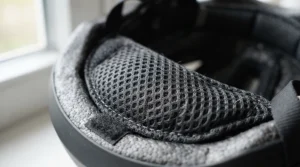
Cheek pad thickness is the sleeper fit tool. Thinner pads loosen the fit and thicker pads tighten it. That’s it, and it costs a fraction of a new helmet.
The numbers show how seriously brands treat it. Arai’s GPV-R cheek pads come in thicknesses from 12 mm to 30 mm, with 25 mm standard on sizes XS through MD and XL. Shoei’s GT-Air 3 comes with 39 mm pads on the XS and 35 mm on S through XL. Alpinestars’ Supertech R10 pad range runs from 15 mm (OS15) up to 40 mm (OS40). Notice that small sizes start with thicker pads, because the shell doesn’t shrink as fast as the head does.
For a round head, thinner cheek pads are often the temple-pressure fix. Too thin, though, and the helmet shifts in the wind. Thicker pads stabilize the helmet but can squeeze your cheeks and jaw. Shoei’s RF-1400 pads are interchangeable across all sizes, and HJC’s i10 pads interchange across its shells, so experimentation is cheap. Budget about $60-$90 for a replacement set, depending on the brand.
Full Face Helmet for Narrow Head and Small Riders: The Opposite Problem
If you’re searching for a full face helmet for narrow head and small riders, you have the opposite problem. A narrow, long head needs a long-oval interior, which is uncommon. The Arai Signet-X is the canonical example, and it’s labeled long oval in Arai’s lineup, weighing about 1,600 g in size Medium.
Mismatch hurts in the other direction. A long-oval head in a round helmet gets pressure at the front and back, with gaps on the sides. If you’re a small rider with a narrow head, that’s your cue to look at the Signet-X or at Shoei’s older long-oval moulds.
Why include this here? Because many riders misdiagnose themselves. “Small head” and “narrow head” aren’t the same. Check your top-down photo before you decide. If it’s an egg shape, skip the Arai Quantum-X. If it’s a circle, skip the Signet-X.
For narrow-headed small riders who can’t find a long-oval fit, the standard workaround is the opposite of the round-head fix. Use thicker cheek pads to take up the side gaps. It doesn’t fix a true shape mismatch, but it helps with mild ones.
Practical Guide: Fitting and Breaking In Your Helmet in 30 Days
The first month decides whether a helmet works. Here’s the process.
Day 1: the fit test. Put the helmet on with the strap fastened. Shake your head side to side and nod. The helmet should move your skin, not slide over it. Pressure points that appear in the first five minutes won’t disappear.
Days 2-7: short wear sessions. Wear it around the house for 20-30 minutes at a time. Foam compresses slightly, so a snug fit will soften. Reviewers of the HJC i10 note this exact pattern, with a tight start that eases over time.
Weeks 2-3: first rides. Keep rides short. Watch for forehead pressure, which signals a shape mismatch, and for headaches, which signal a size problem.
Week 4: adjust. If temples feel tight, try thinner cheek pads. If the helmet shifts, try thicker ones.
Common first-month mistakes include buying too large “for comfort,” ignoring early pressure points, and washing pads in hot water. Most manufacturers recommend gentle, cool washes. Check your manual.
Real-World Scenarios: Three Rider Profiles
The college commuter. She rides eight miles daily on a 300 cc scooter, has a very round head, and wears an XS. Her budget is tight, so the HJC i11 is the logical choice. Its round-leaning interior and XS-MD shell suit her, and the Snell 2025 rating is a bonus.
The weekend tourer. He rides 150-mile days on a naked bike, has a mildly round head, and wants a quiet helmet. The Shoei RF-1400 fits that profile, since its interchangeable cheek pads let him fix any temple pressure. The premium price is justified by his mileage.
The track-day rider. She’s small, mildly round, and cares about weight. The Scorpion EXO-R1 Air gives her the lightest option here, with an adjustable fit to compensate for its intermediate-oval shape. If she’s very round, she should try the Arai Quantum-X instead.
Notice how budget, mileage, and head shape each tip the choice. There’s no single best helmet, only the best one for a specific rider.

Problem and Solution: Fixing Common Fit Issues
Temple pressure. Swap to thinner cheek pads, or try a rounder helmet. The Arai Quantum-X and HJC i11 are built for this.
Forehead hot spot. This usually means the shape is too oval or the size is too small. Try one size up, but check that cheek contact stays firm.
Helmet shifts when you turn your head. The helmet is too big or the cheek pads are too thin. Try thicker pads before sizing down.
Wind noise. Some round-oval designs, including the Arai Quantum-X, draw noise complaints. Earplugs help, and a proper fit reduces turbulence.
Fogging. Look for Pinlock-ready shields. The HJC i10 and Scorpion EXO-R1 Air both include anti-fog provisions.
Full Face vs Modular and Open-Face for Small Round Heads
| Type | Protection | Round-Head Fit | Weight | Best For |
|---|---|---|---|---|
| Full face (e.g., HJC i11) | Highest, chin and face covered | Wide choice, round-leaning options exist | Lighter than modulars | Daily riding, highway |
| Modular (flip-up) | High, but hinge adds complexity | Fewer round-oval options | Heavier due to hinge | Touring, glasses wearers |
| Open-face | Limited, no chin protection | Easy to fit | Lightest | Low-speed city riding |
Full face wins on protection and on options. Modulars are heavier because of the hinge mechanism, which small necks feel over long rides. Open-face helmets are easier to fit but leave your jaw exposed.
For a small round head, full face is the safest and most flexible choice. If you wear glasses or need frequent chin-bar flip-ups, a modular is worth considering, but check its shape before buying.
Common Mistakes When Buying a Helmet for a Small Round Head
Buying by size alone. A correct size in the wrong shape still hurts. Shape comes first.
Choosing too large “for comfort.” A loose helmet can shift in a crash, which defeats its purpose. A snug fit that loosens slightly is better than a loose fit that never tightens.
Ignoring shell count. Two helmets in the same size can feel completely different if one uses a proportional shell.
Skipping the pad swap. Cheek pads cost far less than a new helmet and fix many fit complaints.
Trusting a single review. One rider’s “perfect fit” is another’s pressure point. Cross-check shape specs against your own head.
Buying an uncertified helmet. Novelty helmets look like the real thing but lack the energy-absorbing liner that protects you in a crash.
Price Range and Long-Term Value
| Tier | Helmets | What You Gain | Best For |
|---|---|---|---|
| Under $300 | HJC i10, HJC i11, Scorpion EXO-R430 | Certified protection, round-leaning fits | First-time buyers, commuters |
| $450-$500 | Scorpion EXO-R1 Air | Light weight, track-day features | Weight-sensitive riders |
| $650-$850 | Shoei RF-1400, Arai Regent-X, Arai Quantum-X | Multiple shells, premium build, true round-oval option | High-mileage, long-term riders |
Budget helmets protect you well. Premium helmets win on shell sizing, noise, and long-term durability. For a very round head, the Arai Quantum-X is the premium pick, and the HJC i11 is the value pick.
Cost per use favors the premium tier for high-mileage riders. A $750 helmet used for five years costs about $150 a year. A $170 helmet replaced every three years costs about $57 a year. The math depends on how much you ride and how much comfort matters to you. Also budget for replacement cheek pads, usually $60-$90.
Safety and Certification: What the Labels Mean
In the United States, a helmet for on-road riding must meet the Federal Motor Vehicle Safety Standard No. 218. Manufacturers certify their own helmets, and the DOT mark is their declaration of compliance. NHTSA doesn’t “approve” helmets in advance, but it buys and tests certified helmets periodically for enforcement.
NHTSA’s novelty helmet research explains why certification matters. Novelty helmets lack the energy-attenuating liner of a certified helmet, so impact forces transfer to your head instead.
Snell is an additional voluntary standard, and ECE 22.06 is the European standard. The HJC i11 carries Snell 2025, the Scorpion EXO-R1 Air lists ECE 22.06, and the Arai Quantum-X lists both Snell 2025 and DOT. More certifications don’t automatically mean better protection, but they do mean more independent testing.
FAQ
❓ Should a small round head wear a youth helmet?
❓ Is it better to size down to fix a loose helmet?
❓ How tight should new cheek pads feel?
❓ Are HJC helmets a good choice for round heads?
❓ Can I buy a round-oval helmet online without trying it?
Conclusion
Finding a full face motorcycle helmet for small round head riders comes down to three questions. Is the interior shape round enough? Is the shell sized for a small head? Can you tune the padding? The Arai Quantum-X answers the first question best, the HJC i11 offers the best value, and the Shoei RF-1400 and Arai Regent-X answer the shell and padding questions with premium polish.
Start with your head shape, not your budget. Measure carefully, shortlist two or three helmets, and try them on. A helmet that fits your head properly is one you’ll actually wear, which is the point of buying one.
Recommended for You
- Dual Visor Full Face Helmet for Riders With Glasses: 7 Best (2026)
- Full Face vs Modular Helmet for Commuting: 7 Best Picks (2026)
- Full Face Helmet with Pinlock Ready Visor for Fogging: 7 Best 2026
Disclaimer: This article contains affiliate links. As an Amazon Associate, I earn from qualifying purchases. If you purchase products through these links, we may earn a small commission at no additional cost to you.
✨ Found this helpful? Share it with your friends! 💬🤗
