
In This Article
Full face vs modular helmet for commuting comes down to one trade. A fixed one-piece chin bar is the simplest, strongest structure. A hinged chin bar flips up at stops for convenience. Both can protect well when certified and latched. Your route, your stops, and your tolerance for noise decide the winner.

Commuting is a strange kind of riding. You make short hops, wait at red lights, grab a coffee, and chat with the parking attendant. Unlike a weekend canyon run, you put the helmet on and take it off constantly, and that single fact tilts the whole debate. A fixed chin bar is stiffer and quieter. A flip-up is friendlier to a day full of stops. Neither is automatically “safer” once you factor in certification, fit, and whether you actually wear the thing on every ride.
The stakes are not abstract. NHTSA reports that 6,228 motorcyclists were killed in 2024, roughly 16% of all traffic fatalities, and that DOT-compliant helmet use was only 74% in 2023. That means about a quarter of riders are still gambling.
This guide covers seven real helmets across budget, mid-range and premium tiers. It also digs into chin bar strength, ease of putting on, and ventilation airflow, then ends with a decision framework for choosing a full face or flip up helmet for daily commute use. You’ll also get a clear-eyed look at full face versus modular helmet for city riding safety. All prices are ranges from late-2026 research, so check current price before you buy.
Quick Comparison Table: 7 Commuter Helmets at a Glance
| Helmet | Type | Approx. Weight | Key Certifications | Price Range | Best For |
|---|---|---|---|---|---|
| Shoei RF-1400 | Full face | ~3.64 lb | Snell M2020, DOT (verify ECE on your variant) | ~$800-$950 | Long, quiet daily miles |
| Bell Qualifier DLX MIPS | Full face | ~3.6 lb | DOT | ~$200-$300 | Budget safety tech |
| HJC i10 | Full face | ~3.8 lb | DOT, Snell M2020 | ~$150-$200 | Hot climates, glasses wearers |
| Shoei Neotec 3 | Modular | ~4.0-4.15 lb | DOT; ECE 22.06 per UK testing | ~$900-$1,050 | Quiet premium flip-up |
| LS2 Advant X | Modular (180° flip) | ~3.6 lb (1,650 g) | ECE 22.06 P/J, DOT | ~$430-$500 | Rider who flips often |
| HJC i100 | Modular (flip-over) | ~4+ lb | ECE 22.06 (confirm DOT label) | ~$300-$360 | Budget modular |
| AGV Streetmodular | Modular | ~4.31 lb | DOT, ECE 22.06, P/J | Check current price | Latch-hardware confidence |
Read the table as a map of trade-offs, not a ranking. The full face helmets run lighter and cheaper at every tier. The modulars cost more per feature but reward you every time you stop. If your commute has more than three or four stops, the extra weight of Shoei Neotec 3, HJC i100 or AGV Streetmodular buys real convenience. If you ride long, uninterrupted stretches, the Shoei RF-1400 and HJC i10 simply do less wrong.
💬 Just one click — help others make better buying decisions too!😊
Top 7 Helmets for Full Face vs Modular Helmet for Commuting: Expert Analysis
1. Shoei RF-1400 — quietest full face for daily miles
Quiet is the headline. For anyone riding 45 minutes each way, wind roar is a fatigue tax that builds silently and shows up as slower reactions late in the ride. The Shoei RF-1400 weighs about 3.64 lb with a fiberglass AIM+ shell and carries Snell M2020 and DOT certification. Some listings also show ECE, so verify your variant’s label. It ships with a Pinlock EVO insert, which matters on drizzly November mornings because it separates a clear visor from a wipe-at-every-light routine.
On paper, a fixed chin bar means no hinge, no latch and nothing to loosen after years of daily use. Based on the spec comparison, this is the benchmark the modulars below are measured against, and it suits riders who rarely remove the helmet between stops. The snug cheek pads and tight visor seal cost a little ease of putting on, but they buy a calmer cabin.
Review roundups and retailer pages cluster around 4.6 out of 5. Reviewers repeatedly praise low noise and the visor seal, and they note the pads feel tight until they break in.
Pros:
- ✅ Among the quietest helmets in its class
- ✅ Light fiberglass shell with Snell certification
- ✅ Pinlock EVO included for fog control
Cons:
- ❌ Premium price stings budget commuters
- ❌ Snug fit needs a break-in period
Expect around $800-$950, so check current price. It’s pricey, but fair value if you ride daily for years.

2. Bell Qualifier DLX MIPS — budget full face with MIPS and auto-tint
Here’s the surprise at this price: a MIPS slip-plane liner and a photochromic visor that darkens in sunlight. For a commuter who rolls from a dim garage into harsh glare and back, that adaptive shield eliminates a daily visor swap. The Bell Qualifier DLX MIPS uses a polycarbonate shell at roughly 3.57 lb and carries DOT certification.
MIPS adds a low-friction layer between padding and the EPS liner, aimed at rotational forces from angled impacts. Here’s the honest caveat. The UK’s SHARP program rated the non-MIPS DLX at three out of five stars, so treat it as a solid budget lid rather than a premium-safety benchmark. It’s best for riders who want modern features without a premium bill.
Aggregated owner feedback is largely positive on comfort, airflow and value. The most common complaint is noise, and one long-term review notes air sneaks in around the shield and lower edge even with vents closed. Bell’s lineup has been shuffling, so confirm the exact variant.
Pros:
- ✅ MIPS liner at a budget price
- ✅ Photochromic shield reduces visor swaps
- ✅ Strong airflow for hot rides
Cons:
- ❌ Louder than premium shells
- ❌ Mid-pack SHARP score on non-MIPS version
Plan on roughly $200-$300. It’s strong value for the money.
3. HJC i10 — best budget ventilation, glasses-friendly
If you ride in a hot city, this is the helmet that treats ventilation airflow as a priority. The HJC i10 pairs an advanced polycarbonate shell (about 3.8 lb in medium) with DOT and Snell M2020 certification, and the Snell rating is unusual at this price. Its channeling vent system runs air front to back, and there are glasses grooves along the temples.
What does that mean at the curb? Sliding it on over eyewear is far less of a wrestling match, which helps ease of putting on for glasses wearers. The tradeoff is the absence of an internal sun shield, so budget for sunglasses or a tinted visor. Based on the spec comparison, this is the cheapest way into certified full-face commuting.
Reviewers highlight unusually strong airflow and a plush, quiet interior for the money. Retail pages hover near 4.5 out of 5, though some buyers mention the visor fogging and a slightly tight fit.
Pros:
- ✅ Snell and DOT certification at entry price
- ✅ Strong airflow for the money
- ✅ Padding grooves help glasses wearers
Cons:
- ❌ No internal sun shield
- ❌ Fit runs slightly tight
Expect around $150-$200. It’s the best value in this lineup.
4. Shoei Neotec 3 — premium modular that stays remarkably quiet
The Shoei Neotec 3 is the helmet other modulars get compared to. It weighs roughly 4.0-4.15 lb with an AIM shell and offers two chin-bar open positions: one for donning, a more secure one for riding. Low-friction material along the pads and strap area makes ease of putting on genuinely easy, even in thick gloves.
Ventilation is a story of trade-offs. Intake vents on the crown and chin pair with an always-open rear exhaust. A reviewer at Visordown found that the quieter chin curtain also reduced airflow, and ended up removing it. UK testing credits it with a SHARP score of 5/5, with the chin guard staying locked in 93% of tests, which is encouraging on chin bar strength. Certification labels vary by market, so check yours.
Roundups settle around 4.4 out of 5. Reviewers praise build quality and low noise, while complaining about price, weight, a cluttered chin bar, and vent sliders that are fiddly with gloves.
Pros:
- ✅ Excellent noise control for a modular
- ✅ Secure two-position chin bar design
- ✅ Premium fit and finish
Cons:
- ❌ Heaviest lid here besides the AGV
- ❌ Chin curtain trades quiet for airflow
Budget around $900-$1,050. It’s worth it for high-mileage riders.
5. LS2 Advant X — flip-back chin bar for constant on-off riders
A 180° rotating chin bar is the standout. Flip it all the way back and the LS2 Advant X turns into an open-face helmet with the weight balanced behind your head, rather than a chin bar sticking up like a sail. It carries P/J homologation, ECE 22.06 and DOT, so it’s certified in both configurations, and a UK review weighed one at about 1,650 g in size large.
For urban riders, that’s the whole pitch. You can switch to open-face for slow filtering or a quick errand without leaving certified territory. Shape fit varies by retailer notes, so try before you buy. Compared with the premium Shoei Neotec 3, you give up some refinement and gain flexibility at a notably lower price.
Retail pages show roughly 4.5 out of 5. A long-term UK reviewer noted a moist face in heavy rain and an odd-feeling single-tab visor at first. A buyer called the open-face conversion easy.
Pros:
- ✅ P/J certified for both chin positions
- ✅ 180° flip-back balances weight well
- ✅ Reasonable weight for a modular
Cons:
- ❌ Water can seep in during heavy rain
- ❌ Visor tab takes getting used to
Expect around $430-$500 for solid colors. It’s a strong value at this tier.

6. HJC i100 — cheapest way into a flip-over modular
The HJC i100 is HJC’s first flip-over modular, and it undercuts nearly every other modular here. A polycarbonate shell, three shell sizes, a weight just over 4 lb, and ECE 22.06 certification make the HJC i100 attractive. Its vents include a three-position chin vent and a three-position top vent, which tells you ventilation airflow wasn’t an afterthought.
What the spec sheet won’t tell you is how it ages. A BikeSocial reviewer logged roughly 12,000 all-weather miles and found the fit had loosened, though noise stayed acceptable. Reviews on noise vary widely, from fine to loud above 30 mph. A Rider Magazine tester noted the faceshield takes two hands or two movements to close.
If you’re a commuter on a budget who values flip-up convenience, this is the pragmatic pick. If you do mostly highway miles, the quieter full faces make more sense.
Pros:
- ✅ Lowest-cost flip-over modular here
- ✅ Good adjustable ventilation
- ✅ Bluetooth-ready for HJC systems
Cons:
- ❌ Noise opinions range widely
- ❌ Faceshield awkward to close
Plan on around $300-$360. It’s a budget modular with honest trade-offs.
7. AGV Streetmodular — metal-hinge confidence for modular skeptics
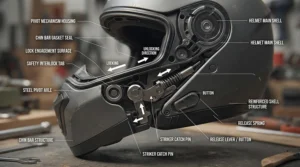
Hardware is the story. The AGV Streetmodular is DOT and ECE 22.06 certified with P/J homologation, and weighs about 4.31 lb in large. Steel hinges and locking pins anchor the chin bar. A red slider locks it open for open-face use. The release sits at the chin bar’s center bottom with a protective tab behind the liner to block accidental opening.
A motorcycling reviewer who describes himself as a lifelong full-face loyalist came away convinced that ECE 22.06 modulars are safe. That’s a useful reality check for skeptics wrestling with chin bar strength. BikeSocial’s testers found it good value but flagged the chin bar release catch as annoying.
It fits riders who want certified protection in both positions, and who accept weight in exchange for latch hardware that feels overbuilt. A consistent U.S. price range wasn’t verifiable at the time of research, so check current price.
Pros:
- ✅ P/J homologation for both configurations
- ✅ Metal hinges and locking pins
- ✅ DOT and ECE 22.06 labeling
Cons:
- ❌ Heaviest helmet in this lineup
- ❌ Chin bar release catch feels fiddly
Value verdict: strong for riders who prize hardware over weight.
✨ Don’t Miss These Exclusive Deals!
🔍 Take your commute to the next level with these carefully selected helmets. Click on any highlighted item to check current pricing and availability. These picks will help you ride with confidence every single morning!
How to Choose Between a Full Face and a Modular Helmet for Commuting
Picking the right helmet is mostly a sequence of honest questions.
- Check the label first. DOT certification is the U.S. baseline, and ECE 22.06 or Snell add extra assurance. A fancy lid without a legal label is a paperweight.
- Count your stops. Five or more removals a day favors a modular. Long uninterrupted rides favor a fixed chin bar.
- Set your noise budget. Modulars typically run noisier because of the hinge gap, so plan on earplugs either way above about 40 mph.
- Confirm P/J if you’ll ride chin-up. A non-P/J modular is certified chin-down only. Chin-up riding is comfort, not certified chin protection.
- Prioritize fit over features. A helmet that fits poorly can’t protect properly. Try it on, move your head, and look for pressure points.
- Match ventilation airflow to climate. Hot city? Prioritize vents. Cold mornings? A sealed chin curtain helps.
- Add the costs people forget. Budget for a Pinlock insert, a comms unit, and replacement within about five years.

Chin Bar Strength: What the Standards Actually Prove
Chin bar strength is the argument that never dies. It’s worth separating myth from measurement. Dainese’s explainer on ECE 22.06 notes that a P/J modular must pass both the full-face and open-face test series. Other standards guides add that chin protection is only guaranteed with the chin guard in position, which is why a modular’s job is to stay shut.
| Standard / Label | What It Signals | Best For |
|---|---|---|
| DOT (FMVSS 218) | U.S. legal minimum | Anyone riding legally in the U.S. |
| ECE 22.06 | Newer tests, with rules specific to modulars | Riders wanting modern testing |
| P/J | Certified chin-down and chin-up | Chin-up riding on LS2 Advant X or AGV Streetmodular |
| Snell M2020 | Voluntary, stricter lab standard | Fixed chin bars like Shoei RF-1400 or HJC i10 |
The table tells you the latest ECE testing has closed much of the old gap, but not all of it. Cardo’s helmet guide notes that modulars rarely meet Snell’s chin bar standard, and it cites the often-repeated figure that roughly a third of crash impacts hit the chin. Weigh that against the Shoei Neotec 3‘s strong UK testing. The practical takeaway: certified chin bar strength is no longer the weak link, but a worn latch or loose hinge can be. Thumb-test the closed bar regularly.
Full Face Versus Modular Helmet for City Riding Safety
City riding is a lot of low-speed risk and a few nasty high-speed ones. The classic Hurt Report found that helmets significantly reduce deaths and brain injuries without raising neck-injury risk. It also found that in roughly two-thirds of motorcycle-car crashes, the driver failed to see the rider. So the first safety move is being visible and wearing a certified lid every single ride.
On that front, the full face versus modular helmet for city riding safety debate hinges on discipline. A flip-up that stays down in traffic offers certified protection. One flipped up at speed, if it isn’t P/J, steps outside tested territory. Some traditional modulars also pivot the chin bar upright, where it can act like a sail on your head. Rule of thumb: chin bar up at stops, chin bar down in motion, unless your helmet is P/J and you accept the comfort trade.
Ease of Putting On: Where Modulars Pull Ahead
Ease of putting on is where modulars quietly win. Glasses wearers know the struggle of forcing a fixed chin opening over frames, and one retailer guide notes it can bend them. With a modular, you lift the chin bar, settle the helmet, adjust your glasses, then close it.
Consider the details. The Shoei Neotec 3‘s low-friction pad surfaces smooth donning. The HJC i10 counters with temple grooves in a full face shell. The Bell Qualifier DLX MIPS and Shoei RF-1400 rely on a snug, break-in fit. Gloves matter too. Fiddly vent sliders and chin bar releases are daily annoyances. For anyone who gears up in a hurry, ease of putting on can be the deciding vote.
Ventilation Airflow: Why the Chin Bar Gap Matters
Ventilation airflow and noise fight each other. More openings mean more air and more sound. The HJC i10 and Bell Qualifier DLX MIPS lean toward airflow, and reviewers note that both move a lot of air. The HJC i100 offers three-position chin and top vents, and the Shoei Neotec 3 gives you slider-controlled intake with an always-open exhaust.
The hidden variable is the chin curtain. It quiets a modular, and it also chokes airflow. The same trade shows up in how modulars handle summer. A flip-up chin bar is the ultimate vent at a red light. At speed, though, the gap between chin bar and shell is the usual source of extra noise. If you commute in heat, favor vents you can actually reach with gloved fingers.
Full Face or Flip Up Helmet for Daily Commute: Who Should Pick What
The answer to full face or flip up helmet for daily commute use depends on you.
| Feature | Full Face | Modular | Open Face (3/4) |
|---|---|---|---|
| Chin protection | Fixed, simplest | Strong when latched and certified | None |
| Convenience | Lowest | Highest | High |
| Noise | Quietest | Typically louder | Loudest |
| Weight | Lightest | Heavier | Lighter |
| Best For | Shoei RF-1400, HJC i10 | LS2 Advant X, HJC i100 | Short, slow rides only |
This comparison shows why most commuters end up choosing between the first two columns. Open face is cooler but leaves your jaw exposed. Full faces win on weight and noise, while modulars win on stops and glasses. If you want the fewest compromises on chin bar strength and noise, pick fixed. If convenience drives your day, pick a certified modular.
Beginners on a budget should look at the HJC i10. Glasses wearers and frequent-stoppers fit the LS2 Advant X. High-mileage riders with deep pockets should consider the Shoei Neotec 3 or Shoei RF-1400.
Practical Usage Guide: Your First 30 Days With a New Commuter Helmet
Most helmet problems appear in the first month, and a few habits prevent most of them.
- Week one: fit check. The helmet should feel snug without pressure points. Shake your head side to side and nod. If it shifts, size down or try a different shape.
- Break-in expectations. Premium pads like those in the Shoei RF-1400 loosen over roughly 20 hours of riding, so don’t judge fit on day one.
- Latch test (modulars). Press the closed chin bar with your thumb every few weeks. Any play means stop riding and inspect it.
- Visor care. Fit the Pinlock insert before the first wet ride, and clean it with mild soap rather than paper towels.
- Cleaning schedule. Wash removable liners monthly if you commute in heat, since sweat degrades padding faster.
- Comms install. Add Bluetooth gear before you ride far, because routing wires later is a hassle. The HJC i10 and HJC i100 are built to accept HJC’s own system.
Real-World Scenarios: Three Commuters, Three Helmets
Scenario 1: The highway grinder. Picture a rider logging 40 miles each way at 65 mph, rain or shine, with a $1,000 gear budget. Noise and chin bar strength dominate, so the Shoei RF-1400 is the logical match, with earplugs and a Pinlock insert.
Scenario 2: The city hopper. A student making eight short trips a day, wearing glasses, with a ~$350 budget. Ease of putting on matters more than speed. The HJC i100 or the LS2 Advant X make sense, and the LS2 Advant X wins if budget stretches.
Scenario 3: The summer courier. A delivery rider in a hot climate, in and out of buildings all day, on a tight budget. Airflow and low cost lead the decision, which points to the HJC i10 or Bell Qualifier DLX MIPS.
The pattern is clear. Match the helmet to how often it’s on your head, not to the rider you wish you were.
Common Mistakes When Buying a Commuter Helmet
The most common error is buying on looks and graphics, then discovering the fit is wrong. Another is assuming “modular” means “open-face certified.” It doesn’t unless you see P/J. A third is skipping the label check. NHTSA’s guidance on choosing the right motorcycle helmet points riders to the DOT symbol on the back of the shell, and that’s where every purchase should begin.
Other pitfalls include chasing the lowest price and ignoring replacement visors, ordering without trying sizes, and overvaluing weight differences of a few ounces over long-term comfort. Finally, don’t let a cheap price excuse a poor fit. A loose helmet at a bargain price is the most expensive option you can buy.
Long-Term Cost & Maintenance: What a Helmet Really Costs Per Year
Sticker price misleads. Manufacturers generally recommend replacing a helmet roughly every five years or after any significant impact, and some, like Shoei, back theirs with long warranties. Spread the cost over five years and the numbers shift.
A Shoei Neotec 3 at around $900-$1,050 works out to roughly $180-$210 a year. A Shoei RF-1400 at about $800-$950 comes to $160-$190. A HJC i10 at roughly $150-$200 is only $30-$40 a year. Add Pinlock inserts, replacement visors, and a comms unit, and the budget helmets still win on cost.
The fair question is whether the premium helmets deliver enough quiet and comfort to justify a gap that large. For daily highway riders, often yes. For short city hops, rarely.
FAQ
❓ Can I ride with a modular helmet chin bar up in the city?
❓ Are modular helmets legal in the U.S.?
❓ What is the best commuter helmet under $300?
❓ Do modular helmets work with glasses?
❓ How often should I replace my commuter helmet?
Conclusion
So, which wins? For a pure full face vs modular helmet for commuting verdict, the fixed chin bar wins on weight, noise and structural simplicity, while the certified modular wins on convenience, glasses, and constant stops. Neither is reckless when it’s DOT or ECE labeled and properly fitted.
Pick the Shoei RF-1400 if you ride long and quiet matters. Choose the HJC i10 or Bell Qualifier DLX MIPS for budget-minded city hops. Go modular with the LS2 Advant X or AGV Streetmodular if P/J certification and flip-up convenience fit your day, and the Shoei Neotec 3 if you want the premium path. The HJC i100 covers the budget end.
Whichever you land on, the best full face or flip up helmet for daily commute use is the one you’ll actually wear, fitted correctly, every single ride.
✨ Ready to Upgrade Your Ride?
🔍 Take your commute to the next level with these carefully selected helmets. Click on any highlighted item to check current pricing and availability. These picks will help you ride safer, quieter, and more comfortably every day!
Recommended for You
- Dual Visor Full Face Helmet for Riders With Glasses: 7 Best (2026)
- Full Face Motorcycle Helmet for Small Round Head: 7 Best (2026)
- Full Face Helmet with Pinlock Ready Visor for Fogging: 7 Best 2026
Disclaimer: This article contains affiliate links. As an Amazon Associate, I earn from qualifying purchases. If you purchase products through these links, we may earn a small commission at no additional cost to you.
✨ Found this helpful? Share it with your friends! 💬🤗
