
In This Article
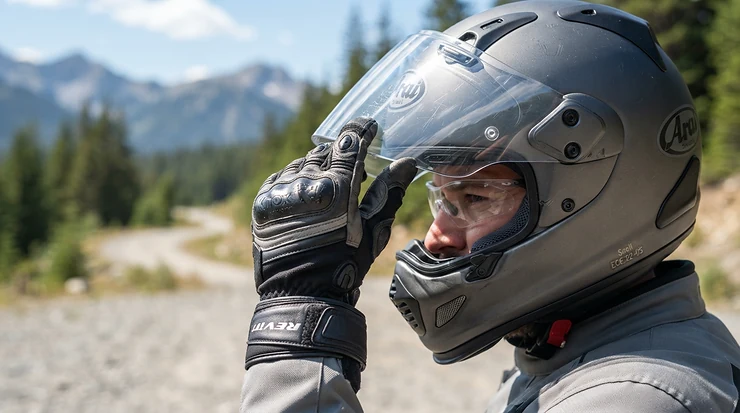
A dual visor full face helmet for riders with glasses is a fully enclosed motorcycle helmet that pairs a clear outer face shield with a retractable internal sun visor. Its interior is also shaped to hold eyeglass frames, usually through an eyeglass channel and temple grooves cut into the padding. In short, it gives you sun control and spectacle comfort in one shell. 🕶️

Anyone who wears glasses knows the helmet-fitting ritual. You shove the lid on, and the temple arms bite into your skull like tiny angry crabs. Twenty minutes later you’ve got a headache and a dent over each ear. Then the sun drops to eye level on the highway, and you’re squinting through a clear shield. The standard fixes are to swap in a tinted shield, wear sunglasses under a helmet that barely fits them, or suffer. Not great.
A well-designed dual visor setup solves both problems at once. A drop-down shade handles glare, and the interior padding gives your frames somewhere to live. As this rider’s guide to wearing glasses with a motorcycle helmet points out, more full-face helmets are now designed with eyeglass wearers in mind, but they are far from equal.
This guide compares seven real helmets, from a premium touring benchmark to budget dual-visor options. It explains what each feature means once the helmet is on your head, and it covers the fit tricks, safety standards, and buying mistakes that spec sheets skip. Prices appear as ranges only, and review commentary is aggregated sentiment from public listings, not personal testing.
Quick Comparison: 7 Helmets at a Glance
Here’s the lay of the land before the deep dive. Prices are ranges or tiers based on retailer listings at the time of research and change often, so check current price before you buy.
| Helmet | Sun Control | Glasses Features | Price Range | Best For |
|---|---|---|---|---|
| Shoei GT-Air 3 | QSV-2 internal drop-down visor | Eyeglass-compatible interior | Premium, roughly $700-$900 | Long-distance touring |
| HJC i100 | Large drop-down, three positions | Internal grooves for glasses | Around $300-$350 | Modular flexibility |
| HJC i90 | HJ-V9 drop-down, three positions | Glasses groove | Mid-$200s to low $300s | Value-focused commuters |
| LS2 Challenger | Internal sun visor | Not confirmed in sources checked | Mid-range tier, check price | Lightweight sport-touring |
| LS2 Stream II | Drop-down sun visor | Verify at fit | Mid-range tier, check price | Daily riding on a budget |
| ILM WS902 | Removable outer visor plus drop-down shade | Wide eyeport | Budget tier, check price | Adventure and dual sport |
| 1Storm HJK316 | Dual visor with sun shield | Verify at fit | Budget tier, check price | First-time buyers |
Read the table as a map, not a verdict. The Shoei GT-Air 3 is the only helmet here with a long, documented glasses-and-sun-visor pedigree, but it costs several times what the budget picks do. The two HJC models sit in the sweet spot, because both pair a drop-down shade with dedicated glasses grooves at a fraction of the Shoei’s price. The budget end (ILM WS902 and 1Storm HJK316) is where you must verify fit with your own frames, since glasses-specific claims are thinner.
💬 Just one click — help others make better buying decisions too!😊
Top 7 Dual Visor Full Face Helmets for Riders With Glasses: Expert Analysis
1. Shoei GT-Air 3 — quiet touring ride with a roomy QSV-2 sun visor
The Shoei GT-Air 3 is the benchmark here, and it earns the spot through details. Its QSV-2 internal sun shield deploys from a large slider you can find with a gloved thumb. A shell designed in the wind tunnel cuts frontal drag by roughly 6% and lift by about 11% compared with its predecessor, according to retailer product notes. In practice that means less neck fatigue at highway speed, and for glasses wearers less buffeting that nudges frames out of place.
The interior is listed as eyeglass compatible, and the visor is rated to meet the ANSI Z80.3 standard for non-prescription eyewear. The fit is intermediate oval and the helmet weighs about 3.78 lbs, which is respectable for fiberglass touring construction. Shoei includes a Pinlock insert, which matters because glasses plus fogging is a miserable combination.
Who’s it for? Riders doing 200-mile days who want the shade, the quiet, and the comfort to disappear. Reviewers at major US retailers rate it around 4.5 out of 5 across roughly 70 to 80 reviews. Common themes are premium feel and quietness, with price as the usual complaint. Sizing is also strict, so measure your head before ordering.
Pros:
- ✅ Large, easy-to-reach QSV-2 internal sun visor
- ✅ Wind-tunnel shell reduces drag and lift
- ✅ Pinlock insert included for fog control
Cons:
- ❌ Premium price puts it out of reach for many
- ❌ Intermediate oval shape won’t suit every head
Price range: roughly $700-$900 depending on graphic. It’s a splurge, but the cost-per-ride math works if you keep it for years.

2. HJC i100 — modular chin bar plus a tall three-position shade
The HJC i100 is technically a modular helmet, so it flips from full-face to open-face. Closed up, it works as a full face lid, which is why it earns a place here. Its standout feature is the drop-down sunshield, which one HJC i100 review from Ultimate Motorcycling describes as taller than most, leaving less unshaded gap underneath. That small detail removes a distraction riders often notice on cheaper shades.
On paper, the One-Touch mechanism gives three riding positions, so you can park the shade halfway when the sun is low. Listings confirm internal grooves for glasses or sunglasses and a Pinlock-ready HJ-36 shield with the lens included. That’s a rare value combination at this price.
A cautionary note from that same reviewer: prescription photochromic lenses combined with the shade created a smoky haze. If your glasses darken in sunlight, test the pairing before committing. Retail buyers report the shade is easy to adjust and the fit works with glasses. The usual trade-off is weight, since the i100 runs about 4.19 lbs, heavier than a typical fixed-chin-bar helmet.
Pros:
- ✅ Tall drop-down shade with three positions
- ✅ Internal grooves designed for glasses wearers
- ✅ Pinlock-ready shield with lens included
Cons:
- ❌ Heavier than most full-face helmets
- ❌ Chin bar adds noise versus fixed designs
Price range: around $300-$350. For a modular with these features, the value verdict is strong.
3. HJC i90 — the budget-friendly sibling with a proven glasses groove
The HJC i90 is the more affordable sibling of the i100. It’s also a modular, and it shares the philosophy: a larger HJ-V9 drop-down sun visor with the One-Touch mechanism and three positions, plus a glasses groove explicitly called out in the specs. The shell is polycarbonate composite, which keeps costs down, and the RapidFire system swaps the shield without tools.
The spec sheet tells a clear story for glasses wearers: the HJ-V9 shade is wider than its predecessor’s, which means fewer peripheral blind spots. The SuperCool liner wicks moisture, and cheek pads are designed to leave channels for temple arms. Consumer guides, including SlashGear’s tips for wearing glasses with a motorcycle helmet, single it out as an affordable pick for spectacle wearers.
Reviewer sentiment is notably solid: retailers show an average around 4.5 out of 5 across roughly 460 to 500 reviews, a much larger sample than most helmets here. One note: the HJ-33 shield is Pinlock-ready, but in the US the lens insert is sold separately, so budget a few extra dollars.
Pros:
- ✅ Glasses groove plus wide drop-down shade
- ✅ Large review base averaging about 4.5 stars
- ✅ Tool-free shield swaps with RapidFire
Cons:
- ❌ Pinlock insert not included in US packages
- ❌ Modular design is heavier than fixed full-face
Price range: mid-$200s to low $300s. This is the helmet I’d point cost-conscious glasses wearers toward first.
4. LS2 Challenger — lightweight sport-touring shell with internal sun visor
The LS2 Challenger targets riders who want a lighter, sportier feel without giving up a drop-down shade. Listings describe a fibreglass composite shell, an internal sun visor, and a Max Vision shield with a wide eyeport. A published weight of about 1,420 grams (just over 3.1 lbs) makes it one of the lightest helmets in this group.
That low weight matters for glasses wearers more than you’d think. A lighter helmet shifts less on bumps, so your frames don’t slide down the nose bridge. Emergency-release cheek pads and a chin curtain for wind noise also appear in the specs.
Now the honest gap. In the sources checked, I couldn’t verify a dedicated eyeglass channel or temple grooves for this model, so treat glasses compatibility as unconfirmed until you try one on. Review data is thin too: a UK retailer shows a high average, but from only nine reviews, which is too small to trust. US availability and pricing vary by retailer, so confirm stock and check current price before planning around it.
Pros:
- ✅ Very light at roughly 1,420 grams
- ✅ Internal sun visor with a wide-view shield
- ✅ Emergency-release cheek pads included
Cons:
- ❌ Glasses-specific features not confirmed in sources
- ❌ Small review sample makes sentiment uncertain
Price range: mid-range tier. A good fit for riders who’ll try before they buy.
5. LS2 Stream II — an entry-level drop-down shade for daily commuting
The LS2 Stream II shows up in budget-to-mid-range roundups specifically for its drop-down sun visor. It’s a straightforward full-face design aimed at commuters who want sun control without paying touring-helmet money.
Here’s the problem with thin data: beyond the drop-down shade, I couldn’t verify detailed specs like weight, shell material, or any glasses channel. That’s a useful lesson in itself. A shade without a matching interior is only half the solution, because you can solve glare and still crush your temples. If you’re considering this helmet, treat it as a candidate and check three things in person: whether the temple arms slide in without pressure, whether the shade clears your frames when lowered, and whether the helmet closes without shoving your lenses against the shield.
Reviewer sentiment is not something I can responsibly summarize here, since I couldn’t find a trustworthy aggregated sample. Better to say so than to invent one. If you want a drop-down shade on a modest budget, it belongs on the shortlist, but behind the HJC models in confidence.
Pros:
- ✅ Drop-down sun visor at an accessible tier
- ✅ Straightforward full-face design for commuting
- ✅ Simple controls with no modular complexity
Cons:
- ❌ Glasses-specific details couldn’t be verified
- ❌ Limited aggregated review data available
Price range: mid-range tier, check current price. Value verdict: promising but verify fit before buying.

6. ILM WS902 — removable outer visor plus drop-down shade for adventure riding
The ILM WS902 is the odd one out, a dual-sport adventure helmet with a literal dual visor setup. Its oversized outer visor is removable, sitting above an ultra-wide eyeport that listings say is Pinlock 30 compatible (the insert isn’t included). Inside, an internal drop-down sunshield keeps sun out of your eyes. Weight is listed near 3.64 lbs.
Why does this suit glasses wearers? Adventure helmets are built with large eyeports so goggles fit, and that extra room also helps spectacles. The wide opening gives frames space to breathe, and the peak visor blocks overhead sun before it ever reaches the shade. Editorial roundups have scored it highly, though those are editorial ratings, not buyer reviews.
The trade-off is highway behavior. A peaked visor can catch wind at speed, creating lift and noise, and some riders remove it for pavement. Also note that I couldn’t confirm dedicated temple grooves, so test the fit with thick-framed glasses.
Pros:
- ✅ Removable peak visor plus internal drop-down shade
- ✅ Wide eyeport gives frames extra breathing room
- ✅ Pinlock 30 compatible shield
Cons:
- ❌ Peak can catch wind at highway speed
- ❌ Dedicated glasses grooves not confirmed
Price range: budget tier, check current price. For dirt-and-pavement riders, the value is hard to beat.
7. 1Storm HJK316 — the cheapest way to get a real dual visor
The 1Storm HJK316 is the pure budget play: a full-face street helmet with a dual visor and sun shield arrangement. Retail listings show an average around 4.7 out of 5 across roughly 84 ratings on one large marketplace. That’s encouraging, though marketplace ratings run higher than enthusiast-forum ratings, so read it as “buyers are generally satisfied at this price.”
Be realistic about what the money buys. Budget helmets usually mean heavier shells, simpler liners, and less refined ventilation. For a glasses wearer, the key question is interior shape, since I couldn’t verify dedicated eyeglass grooves. If your frames are thin and flexible, you’ll likely manage. If you wear thick acetate frames, expect pressure.
The smart way to use this helmet is as a low-risk first purchase or a spare. Order your normal size, wear it around the house for an hour with your glasses on, and return it quickly if hot spots appear. Verify DOT certification on the label before relying on it, as the next sections explain.
Pros:
- ✅ Dual visor setup at a budget price
- ✅ Strong marketplace rating from buyers
- ✅ Wide range of colors and sizes
Cons:
- ❌ Glasses-specific interior unverified
- ❌ Likely heavier with simpler padding
Price range: budget tier, check current price. Value verdict: a decent starter lid if you inspect the fit carefully.
Specs and Rating Signals Compared
| Helmet | Weight | Anti-Fog | Review Signal |
|---|---|---|---|
| Shoei GT-Air 3 | About 3.78 lbs | Pinlock included | About 4.5/5, roughly 70-80 reviews |
| HJC i100 | About 4.19 lbs | Pinlock lens included | Positive retail comments, small sample |
| HJC i90 | Not listed in sources | Pinlock-ready, insert sold separately | About 4.5/5, roughly 460-500 reviews |
| LS2 Challenger | About 1,420 g (3.1 lbs) | Not confirmed | 4.9/5 from nine UK reviews |
| LS2 Stream II | Not verified | Not verified | Not verified |
| ILM WS902 | About 3.64 lbs | Pinlock 30 compatible, not included | Editorial scores only |
| 1Storm HJK316 | Not verified | Not verified | About 4.7/5, roughly 84 ratings |
Looking at the comparison above, the HJC i90 is the most trustworthy value pick because its review pool is the largest by far, and big samples don’t flatter products. The Shoei GT-Air 3 justifies its premium through verified engineering rather than marketing, while the LS2 Challenger‘s perfect-looking score comes from too few reviews to mean much. For the budget options, the missing data is itself a signal to try before committing.
Practical Usage Guide: Setting Up Your Helmet and Glasses in the First 30 Days
Buying the helmet is only half the job. The first month decides whether you love it. Here’s how to break it in without the usual headaches. 🔧
Days 1-3: Home fitting. Wear the helmet indoors for 30 to 60 minutes at a time, with your riding glasses on. Hot spots at the temples show up quickly. Mark them mentally, or with a bit of painter’s tape on your frames.
Days 4-10: Short rides. Test the shade at different sun angles. Practice working the slider or lever with gloves on, since fumbling at 60 mph is not the moment to learn it.
The glasses-in routine. Put the helmet on first, then slide your glasses in from the side, arms through the padding channel. Many riders do the reverse and fight the cheek pads. If your frames curve sharply behind the ear, entry is awkward, and straighter temple arms make the process far easier.
Maintenance schedule. Wipe the shade with microfibre and lukewarm water, never glass cleaner, which can cloud coatings. Wash cheek pads monthly if you ride daily. Check the Pinlock seal every few weeks.
First-30-day mistakes. Over-tightening the strap to compensate for a loose fit, ignoring early pressure points, and scratching the shade by wiping dry. Pressure that shows up on day two rarely disappears on day twenty. If it persists after a week, adjust or exchange the pads, because forcing it is how people end up riding without their glasses.
✨ Don’t Miss These Top Picks!
🔍 Take your next ride to the next level with these carefully selected helmets. Click on any highlighted item to check current pricing and availability. The right dual visor full face helmet for riders with glasses turns glare, squinting, and temple pain into history!

Real-World Scenarios: Matching a Helmet to Your Ride
Specs mean little without context, so let’s run three common rider profiles. 🏍️
Scenario 1: The 40-mile highway commuter. Frequent sunrise and sunset glare, highway speeds, a daily 80 minutes in the saddle. Noise and fatigue matter as much as the shade. The Shoei GT-Air 3 is the logical match if the budget stretches, since quietness reduces fatigue over hundreds of hours. If it doesn’t, the HJC i90 gives you the shade and the glasses groove at a fraction of the cost.
Scenario 2: The weekend adventure rider. Mixed pavement and gravel, hot afternoons, goggles sometimes, glasses often. The ILM WS902 matches the use case, with its peak visor blocking overhead sun and a roomy eyeport. You’ll accept some highway buffeting in exchange for versatility.
Scenario 3: The new rider on a tight budget. First bike, first helmet, unsure about gear. The 1Storm HJK316 or LS2 Stream II lower the entry cost, but the plan should include a return window. Buy, test with your glasses for an hour, and exchange if anything pinches.
Scenario 4: The modular fan. If you value open-face flexibility at stoplights and gas stops, the HJC i100 is the pick. Its chin bar rotates fully back, and the grooves and large shade stay available either way. Just remember it’s heavier, which long riders will feel.
How to Choose a Dual Visor Full Face Helmet for Riders With Glasses
Choosing well is a sequence, not a gamble. Work through these steps in order. 📋
- Start with head shape. Intermediate oval fits many heads, but round and long-oval shapes exist. A helmet that fits your head properly leaves room for glasses without extra pressure.
- Confirm a real eyeglass channel. Look for glasses grooves or a recessed channel mentioned in the product specs, not just “glasses friendly” marketing.
- Check the shade’s coverage and travel. A drop-down shade should clear your frames without touching them. Taller shades leave less unshaded gap underneath.
- Test how it works with your lenses. If you wear photochromic lenses, verify there’s no hazy interaction under the shade.
- Insist on anti-fog. A Pinlock-ready shield, ideally with the insert included, because fogging with glasses is miserable.
- Confirm DOT certification. Look for the label inside and out.
- Try before you commit. Wear it for an hour with your actual glasses, and buy where returns are easy.
Weight deserves a footnote. Lighter helmets move less on your head, which keeps frames stable. But a lighter shell isn’t automatically better if the interior is stingy with channels.
Full Face Helmet With Internal Sun Visor for Glasses Wearers: What the Shade Actually Does
A full face helmet with internal sun visor for glasses wearers solves a specific problem: glare changes faster than you can swap shields. A clear shield is right at dusk, a dark one at noon, and nothing is right during a tunnel run. The internal shade turns that into a flick of the thumb.
For spectacle wearers, the shade matters even more. Prescription sunglasses under a helmet are awkward, and many riders skip them entirely. A drop-down shade lets you keep your everyday clear lenses on all day, which means no swapping glasses at a gas station while your visor is smeared.
What to weigh: coverage height, lens quality, and what happens to your frames when the shade is lowered. The HJC i100 and HJC i90 both feature taller, wider shades, while the Shoei GT-Air 3 is built around its QSV-2 system. Reviewers also note one catch: some shades have optical quirks combined with photochromic lenses, so test at midday before buying.
Another practical point: internal shades add a thin layer between your eyes and the world, so keep them scratch-free. A shade with fine scratches turns sunset glare into starburst chaos.
Eyeglass Friendly Full Face Helmet With Drop Down Sunshade: Fit and Operation
An eyeglass friendly full face helmet with drop down sunshade has to get two things right at once. The interior must accommodate frames, and the shade must travel past them without contact. Miss either one and you’ve bought an expensive annoyance.
Start with the geometry. The shade sits just inside the shield, between your face and the shell. If your frames are thick or tall, they might touch the shade when it drops, which creates smudges and rattles. Slim, lightweight frames avoid this. Aviator shapes can also work, but oversize fashion frames tend to cause conflicts.
Next, the operation. Slider mechanisms, like the Shoei’s, are easy to hit with a gloved thumb. Lever systems on HJC models offer three positions, which is handy when the sun is low and you only need partial coverage. Practice the motion until it’s automatic.
Finally, consider the shade’s effect on airflow. Internal shades can trap warm air, so crack the main shield slightly in stop-and-go traffic. A helmet that ventilates well keeps both your glasses and your shade fog-free, particularly when paired with a Pinlock insert.
Eyeglass Channel Explained: Why It Beats Squeezing Frames Under Padding
An eyeglass channel is a recessed groove in the helmet’s EPS liner and padding where your temple arms sit. It’s the difference between a helmet that accepts glasses and one that merely tolerates them. Without it, the arms press against your skull, and the pressure concentrates exactly where bone is closest to skin.
Why does it matter for safety, not just comfort? Because riders who endure pain stop wearing the right gear. Some skip the glasses and squint, and others loosen the strap to relieve pressure. Neither is acceptable. A properly shaped channel keeps the helmet snug and the frames comfortable simultaneously.
How to evaluate one: run your finger along the inner cheek pad edge near the temple. You should feel a visible groove or dip, not a flat surface. Then wear the helmet with your actual frames and check for pressure after ten minutes. A good channel is wide enough that the arm tip doesn’t compress the foam, and deep enough that the cheek pad still seals around your jaw.
Be wary of vague wording. “Glasses compatible” can mean anything. Look for specifics like “glasses groove” or “internal grooves,” as listed for the HJC i90 and HJC i100.
Internal Drop Down Shade vs. Outer Dual Visor vs. Sunglasses
An internal drop down shade is only one way to handle sun. Here’s how the main options stack up, so you can see why the dual visor approach suits glasses wearers best.
| Option | Speed of Change | Works With Glasses | Typical Weakness | Best For |
|---|---|---|---|---|
| Internal drop-down shade (Shoei GT-Air 3, HJC i90) | Instant, one-handed | Yes, if clearance is good | Adds a layer; scratches | Variable light, commuting |
| Removable outer visor (ILM WS902) | Fixed, requires swapping | Yes, wide eyeport | Wind at highway speed | Adventure riding |
| Tinted face shield | Swap required | Yes | Useless in tunnels and dusk | Bright, consistent sun |
| Prescription sunglasses under a clear shield | Take off at stops | Built-in | Tight fit, temple pressure | Short, sunny rides |
The analysis is straightforward. A drop-down shade wins on speed, since you adjust without stopping, which is the main safety advantage. A tinted shield is cheaper but inflexible, and sunglasses under a helmet compound the very pressure problem glasses wearers already fight. The outer visor on the ILM WS902 adds shade from above but doesn’t replace the internal option, so think of it as a bonus for off-road use rather than a substitute.
Temple Grooves: The Tiny Detail That Decides Whether You Ride Comfortably
Temple grooves are small channels molded into the interior padding or liner on each side, aligned with your glasses’ arms. They look insignificant in photos, and they change everything about a long ride.
Think about what happens without them. A helmet compresses the temple arm against the side of your head, and the force grows with every minute. Those red dents riders find after a long day are the result. With grooves, the arm sits in a pocket, and pressure transfers to the stronger parts of the skull instead.
How to check: look for the groove on both sides, check that it extends toward the ear, and make sure it isn’t blocked by the cheek pad. Some helmets also allow removable cheek pads, which let you customize thickness. As one useful glasses-wearer guide notes, temple grooves and removable pads are among the first features to look for when shopping.
Don’t confuse “glasses-friendly” with “grooves.” The HJC i100 and HJC i90 specifically list them, while others on this list leave it unconfirmed. Where it’s unconfirmed, a few weeks of wear can create natural grooves in softer padding, but that’s slow and not guaranteed.
Common Mistakes When Buying a Dual Visor Helmet if You Wear Glasses
Even savvy riders trip over the same potholes. Avoid these. ⚠️
Buying by looks. Graphics are a gamble when fit decides everything. Choose on interior shape first, then pick the color.
Skipping the glasses during fitting. Trying a helmet without your frames tells you nothing. Wear your actual glasses, every time, since different frames change the fit.
Assuming the shade works with all lenses. Photochromic and polarized lenses can interact oddly with internal shades. Test in bright, direct sun.
Ignoring weight. A heavier helmet shifts and presses harder. If the model is modular, expect extra ounces from the chin bar mechanism.
Forgetting anti-fog. The combination of breath, glasses, and a shield is a fog machine. Prefer helmets with Pinlock inserts included or at least supported.
Trusting thin reviews. A 4.9 average from nine reviews tells you almost nothing. Favor large samples, and treat marketplace stars with caution.
Skipping the DOT check. More on that next. A cheap helmet without proper certification isn’t a bargain, it’s a liability.
Safety, DOT and Certification Guide
Comfort means nothing if the helmet doesn’t protect you. In the US, on-road motorcycle helmets must meet Federal Motor Vehicle Safety Standard No. 218, which is what the “DOT” label certifies. The full text lives in the Code of Federal Regulations, including FMVSS No. 218 for motorcycle helmets, which sets minimum performance requirements.
Look for the DOT marking both inside and outside the helmet. Novelty helmets frequently fake labels, and federal regulators have tested these and found that they fail most or all of the standard’s requirements. That’s a serious warning for the budget end of this market.
A few extra notes for glasses wearers. Shields that meet standards for eyewear, like the Shoei’s ANSI-rated visor claim, add confidence about optical quality. Shatter-resistant lenses in your own glasses also matter, since a crash with a broken lens near your eye is a nightmare scenario. Consider polycarbonate lenses when you next update your prescription.
Finally, a helmet is a one-crash product. If you’ve had an impact, replace it, even if it looks fine. And remember that certifications guarantee minimums, not comfort, so use the fit guidance in earlier sections to find the right shell within the safe options.
Long-Term Cost and Maintenance: What Each Helmet Really Costs You
Sticker price is only the opening bid. The real cost is spread across years. Here’s the math.
A premium helmet like the Shoei GT-Air 3 might cost several times a budget option, but if it lasts five years of daily commuting, the cost per ride is small. Premium models also tend to have replaceable parts like cheek pads, chin curtains, and shields, which extend life.
Mid-range models like the HJC i90 and HJC i100 hit a smart balance. You’ll likely replace pads or shields during ownership, and in the US the HJC i90 requires purchasing a Pinlock insert separately. Budget helmets like the 1Storm HJK316 look cheap upfront but may need replacement sooner, and replacement parts can be harder to find.
Maintenance costs are modest. Expect to buy a new anti-fog insert periodically, replace a scratched shield every few seasons, and wash pads regularly. Many manufacturers suggest replacing helmets around five years, because liners and foams age even when unused.
The smart move is to decide how many riding hours you’ll log yearly. High-mileage riders benefit most from premium quietness and durability, while occasional riders can happily choose mid-range value.

Frequently Asked Questions
❓ Can I wear regular prescription glasses under a full face helmet?
❓ Do internal sun visors fog up more with glasses?
❓ Are modular helmets as safe as fixed full face helmets?
❓ How do I know if a helmet is really DOT approved?
❓ Will photochromic glasses work with a drop-down sun shade?
Conclusion
Finding the right dual visor full face helmet for riders with glasses isn’t about chasing the longest feature list. It’s about matching three things: a shade that clears your frames, an interior with a real eyeglass channel and temple grooves, and a shell that fits your head. Get those right, and glare, squinting, and temple pain stop being part of riding.
If you want the proven benchmark, the Shoei GT-Air 3 earns its premium through quiet touring comfort and a well-documented internal shade. For most riders, the HJC i90 and HJC i100 are the smart middle path, pairing drop-down shades with dedicated glasses grooves at a far friendlier cost. The ILM WS902 suits adventure riders, while the LS2 Challenger, LS2 Stream II, and 1Storm HJK316 make sense if you verify the fit yourself first.
Whichever you choose, wear it with your actual glasses, confirm the DOT label, and take advantage of return windows. Prices shift constantly, so check current price before you buy.
Recommended for You
- [Add your blog post link 1]
- [Add your blog post link 2]
- [Add your blog post link 3]
Disclaimer: This article contains affiliate links. As an Amazon Associate, I earn from qualifying purchases. If you purchase products through these links, we may earn a small commission at no additional cost to you.
✨ Found this helpful? Share it with your friends! 💬🤗
